
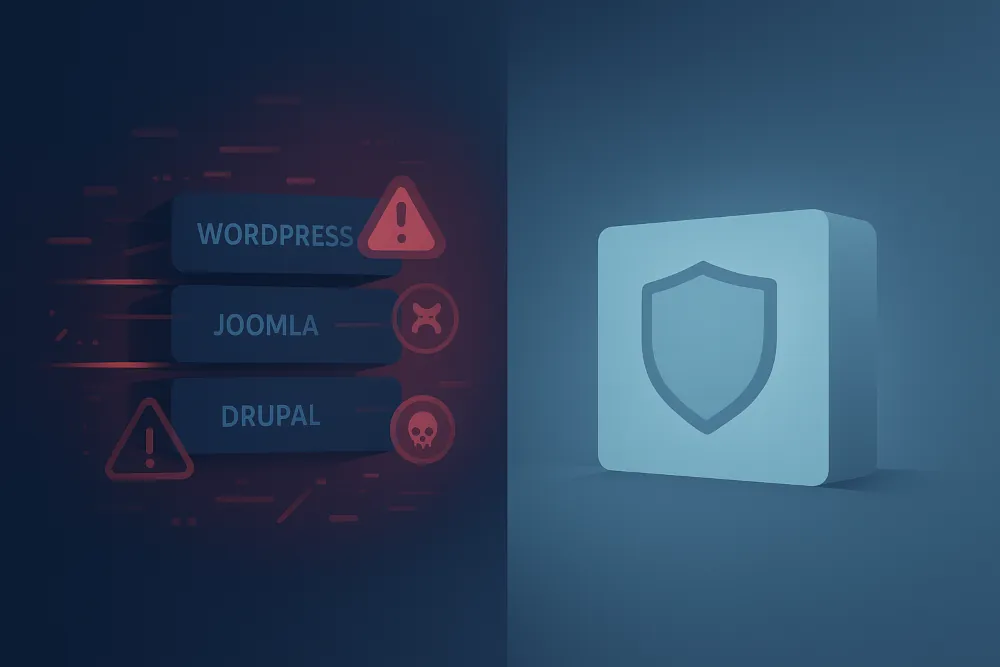
Why Even ‘Secure’ WordPress, Joomla, and Drupal Sites Can Be Hacked
Understanding Why Popular CMS Platforms Are Prime Targets for Hackers — and What Makes Even ‘Secure’ Sites Vulnerable
- Published
Imagine logging in to your website and finding it defaced. Traffic is being redirected. SEO spam is everywhere. You did everything right: updated WordPress, patched all plugins, used strong passwords. Yet, your site is compromised. How is this possible?
Hackers don’t need weak CMS cores. They go after the ecosystem around them — plugins, themes, and extensions. Wordfence and Sucuri report that the majority of WordPress hacks exploit third-party components, not the core platform itself. Automation and mass scanning make even fully updated sites vulnerable.
Why do attackers favor mainstream CMS platforms?
Popularity is a hacker’s playground. WordPress powers nearly 40% of the web. Joomla and Drupal also have millions of sites. More sites = more potential payoff. Even minor vulnerabilities in plugins or misconfigurations become gold mines when multiplied across thousands of targets.
What makes a “secure” site still vulnerable?
Vulnerabilities hide in plugins, abandoned extensions, or incorrect configurations. Excessive admin privileges or weak user permissions create openings. Hackers use automated tools to exploit these small gaps, quietly creating backdoors, injecting spam, or hijacking accounts. Even a fully patched CMS core offers little defense if the surrounding ecosystem is exposed.
How do real attacks unfold?
- Remote code execution through vulnerable plugins
- SQL injections and cross-site scripting via poorly maintained modules
- Unauthorized admin creation
- SEO spam and malicious redirects
Are Joomla and Drupal safer?
Why niche CMS platforms are rarely targeted
- Closed source: hackers can’t inspect the code for vulnerabilities
- No executable PHP and no database access for users
- Admin on a separate domain for extra isolation
- Minimal JavaScript and no third-party plugin system
- Fully managed hosting with proactive security
What does this mean for website owners?
If you rely on WordPress, Joomla, or Drupal: security is not optional. Update immediately, vet plugins carefully, limit permissions, and use strong authentication. But remember: even the most diligent admins face constant attacks.
The ecosystem — plugins, themes, configurations — is where risk lives. Popular CMS platforms trade convenience and flexibility for exposure.
Conclusion: Popularity vs. Security
WordPress, Joomla, and Drupal give you freedom and a vast ecosystem. But popularity comes at a cost: attackers are watching, probing, and exploiting even the most “secure” sites.
Niche platforms like Jademond CMS prove a different philosophy works. By focusing on security-first architecture and removing the usual attack vectors, they allow website owners to focus on growth, not defense. In a world where hackers follow the crowd, sometimes less is truly more.